| Author |
 Topic Search Topic Search  Topic Options Topic Options
|
modirt 
Orange Level Access

Joined: 18 Jul 2018
Location: Missouri
Points: 9933
|
 Post Options Post Options
 Thanks(0) Thanks(0)
 Quote Quote  Reply Reply
 Posted: 19 Sep 2025 at 7:51am Posted: 19 Sep 2025 at 7:51am |
That is a really good resource I wasn't aware of. This one might work........
That assumes 17mm is same as 0.625 diameter shaft on alternator. The math isn't exact, but close. Frustrating that they have to mix apples and oranges (SAE and metric) to to make it more confusing.
Past that........the plot thickens........meaning my education on all this continues. This from Powermaster (whose material is both excellent and abysmal).........
Edit: Measured and it's 6.25" / 2.65 = 2.358 (better than I feared, but still not good)
I'll have to measure, but my guess is OD of big pulley is no more than 5 inches.....turning a pulley of about 2 3/4"......so ratio is not much more than 2:1. At engine RPM of 1,000 fast idle speed, even this high amp alternator is not putting out much juice. Even in use in the field, engine rarely exceeds 2,000 RPM's. Documentation that came with alternator shows it tested to 65 amps at idle speed, but that was with 3:1 ratio. At my idle speed, may not be doing much at all.
So a lot of this then goes to operation. If working at night and are moving from field to barn.......and back........best let the engine rev......(do not shift up)......to get RPM's to 2,500 or more for as long as you can. Alternator really isn't doing much unless you do.
All part of the puzzle.
Edited by modirt - 19 Sep 2025 at 8:48am
|
 |
|
Sponsored Links
|
|
|
modirt
Orange Level Access
Joined: 18 Jul 2018
Location: Missouri
Points: 9933
|
Post Options
Thanks(0)
Quote Reply
Posted: 19 Sep 2025 at 8:58am |
Just got off phone with Powermaster tech support. Long story short, belts as now configured are good to go.
As per those guys, they don't have a 1/2" groove pulley for this alternator. Running high on those grooves at low speed not going to hurt anything. Pulley has OD of 2.65", so is faster than what I can replace it with, which BTW, the pulley is held on by some strange screw setup......maybe along the lines of a tamper proof setup. Not the nut and torque wrench change over some show to use. Best leave it alone.
Alternator kicks in at around 1,800 RPM alternator shaft speed, and comes up to rated speed at around 2,400 RPM, which at my fast idle speed ** will be around 2,400 RPM. Most transit and field work way above that, so should be OK.
** - Fast idle needed when unloading at the barn. Needed to turn the hydraulic pump to get drag chains moving, and is also needed to keep the radiator fan (runs on hydraulic motor) spinning fast to keep cooling system working. Those all speed up and slow down with engine speed. 1,000 RPM is about right.
Edited by modirt - 19 Sep 2025 at 9:07am
|
|
PaulB
Orange Level
Joined: 12 Sep 2009
Location: Rocky Ridge Md
Points: 5435
|
Post Options
Thanks(0)
Quote Reply
Posted: 19 Sep 2025 at 10:08am |
Be aware that if the belts are not down in the groove where the top of the belt is flush with the pully, you are effectively running a larger diameter pulley. Measure what you get for the OD of the belts around you alternator pulley. Do you have a mechanical tachometer that you can actually measure the alternator RPM ?
|
|
If it was fun to pull in LOW gear, I could have a John Deere.
Real pullers don't have speed limits.
If you can't make it GO... make it SHINY
|
|
modirt
Orange Level Access
Joined: 18 Jul 2018
Location: Missouri
Points: 9933
|
Post Options
Thanks(0)
Quote Reply
Posted: 19 Sep 2025 at 10:29am |
Good call.....it may be sitting 1/8" or so proud, so maybe 2 3/4" plus effective diameter of pulley. The one from Brillman better than that, and 1/2" to boot. If I can figure out what "special tools" are needed to make the swap.
No.....do not have a shaft RPM. Just tach on the engine.
But do have an electric meter, so may be able to measure voltages and amps when running to see what I got.
|
|
steve(ill)
Orange Level Access
Joined: 11 Sep 2009
Location: illinois
Points: 93062
|
Post Options
Thanks(0)
Quote Reply
Posted: 19 Sep 2025 at 1:09pm |
|
alternator output is not linear.. Generator output is relative to SPEED... Alternator might take some RPM to kick in, but after that the output is a curve.. running half speed might get you 75% output..( 1200 engine rpm, 2500 rpm alternator).. they are all a little different, but the main advantage of an alternator is good amp output at lower rpm as compared to a generator. .... once an alternator goes above 3000 rpm the output starts to go flat...
Edited by steve(ill) - 19 Sep 2025 at 1:16pm
|
|
Like them all, but love the "B"s.
|
|
iowallis
Silver Level

Joined: 04 Jun 2017
Location: North Iowa
Points: 393
|
Post Options
Thanks(0)
Quote Reply
Posted: 19 Sep 2025 at 3:17pm |
 modirt wrote: modirt wrote:
Frustrating that they have to mix apples and oranges (SAE and metric) to to make it more confusing.
|
And make things simple?? I have done repair work on late 1970s to late 1980s vehicles that are mish-mash of metric and SAE bolts/nuts. There was one manufacture (Chevy?) that 2 out of the 3 starter bolts were metric and the other SAE. Then the Ford 5.4 oil filter, supposedly the engines built in Windsor Canada has SAE threads on the filter and the engine built in Romeo MI (USA) has metric threads.
Sound like you are making much progress on this project, might as well go all the way and restore it to its original, as sold when new, glory.
Edited by iowallis - 19 Sep 2025 at 3:18pm
|
|
Les Kerf
Orange Level
Joined: 08 May 2020
Location: Idaho
Points: 1891
|
Post Options
Thanks(0)
Quote Reply
Posted: 19 Sep 2025 at 9:09pm |
modirt wrote:
Just got off phone with Powermaster tech support. Long story short, belts as now configured are good to go.
As per those guys, they don't have a 1/2" groove pulley for this alternator. Running high on those grooves at low speed not going to hurt anything. Pulley has OD of 2.65", so is faster than what I can replace it with, which BTW, the pulley is held on by some strange screw setup......maybe along the lines of a tamper proof setup. Not the nut and torque wrench change over some show to use. Best leave it alone.
Alternator kicks in at around 1,800 RPM alternator shaft speed, and comes up to rated speed at around 2,400 RPM, which at my fast idle speed ** will be around 2,400 RPM. Most transit and field work way above that, so should be OK.
** - Fast idle needed when unloading at the barn. Needed to turn the hydraulic pump to get drag chains moving, and is also needed to keep the radiator fan (runs on hydraulic motor) spinning fast to keep cooling system working. Those all speed up and slow down with engine speed. 1,000 RPM is about right.
|
It will be just fine. Install a voltmeter if you are concerned (a voltmeter tells you far more than does an ammeter).
|
|
modirt
Orange Level Access
Joined: 18 Jul 2018
Location: Missouri
Points: 9933
|
Post Options
Thanks(0)
Quote Reply
Posted: 20 Sep 2025 at 7:25am |
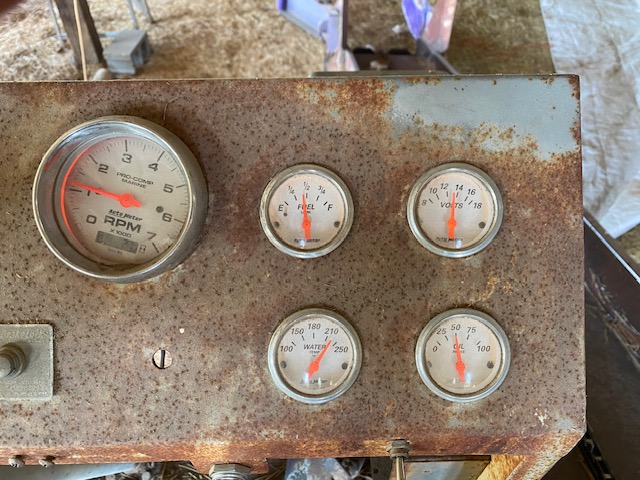
When this thing showed up on my doorstep, don't think any gauges were working (along with a lot of other stuff). One of first things I did to start rehab was to install full set of new gauges. Could not stand operating blind.
Might work OK for a lawnmower, but not a big piece of equipment like
this. Hardest part was to find a tachometer.....with hour meter. Those
are not cheap!! All gauges are Auto Meter.......which offers good quality gauges for automotive and marine use.
Watching the volt meter work was how I concluded changes had to be made.
|
|
modirt
Orange Level Access
Joined: 18 Jul 2018
Location: Missouri
Points: 9933
|
Post Options
Thanks(0)
Quote Reply
Posted: 20 Sep 2025 at 7:29am |
|
As for rest of rehab, once engine is running again with no issues, plan it is to drive it to local welding/fabrication shop for a few welding projects, then start working on getting it painted. Not the full deal, but the visible sheet metal. 50 to 60 years of sitting outside in the weather takes it's toll.
|
|
Les Kerf
Orange Level
Joined: 08 May 2020
Location: Idaho
Points: 1891
|
Post Options
Thanks(0)
Quote Reply
Posted: 20 Sep 2025 at 8:09am |
modirt wrote:
When this thing showed up on my doorstep, don't think any gauges were working (along with a lot of other stuff). One of first things I did to start rehab was to install full set of new gauges. Could not stand operating blind.
Might work OK for a lawnmower, but not a big piece of equipment like
this. Hardest part was to find a tachometer.....with hour meter. Those
are not cheap!! All gauges are Auto Meter.......which offers good quality gauges for automotive and marine use.
Watching the volt meter work was how I concluded changes had to be made.
|
Was this photo taken while running the new alternator? I like to check the voltage with my Fluke 88 meter to verify the calibration of the dash gauge; a full 14 Volts makes me happy  |
|
modirt
Orange Level Access
Joined: 18 Jul 2018
Location: Missouri
Points: 9933
|
Post Options
Thanks(0)
Quote Reply
Posted: 20 Sep 2025 at 8:26am |
|
Yes, but as indicated, was only running slightly over 1,000 engine RPM's. Documentation that came with new alternator says it is set to 14.2 volts charging when operating at "normal" speed. I'm guessing that will be around 2,000 RPM's plus. So far, I've not done more than idle as since it all went back together, has been running hot. I'm thinking thermostat may now be stuck closed having sat dry for past 2 months or so. Either than or water pump went bad just sitting. Have another new issue with an exhaust manifold that has showed up. Need to get that sorted too...........then can take it out on the road for a joy ride to see what happens.
|
|
modirt
Orange Level Access
Joined: 18 Jul 2018
Location: Missouri
Points: 9933
|
Post Options
Thanks(0)
Quote Reply
Posted: 19 May 2026 at 12:00pm |
Les Kerf wrote:
modirt wrote:
When this thing showed up on my doorstep, don't think any gauges were working (along with a lot of other stuff). One of first things I did to start rehab was to install full set of new gauges. Could not stand operating blind.
Might work OK for a lawnmower, but not a big piece of equipment like
this. Hardest part was to find a tachometer.....with hour meter. Those
are not cheap!! All gauges are Auto Meter.......which offers good quality gauges for automotive and marine use.
Watching the volt meter work was how I concluded changes had to be made.
|
Was this photo taken while running the new alternator? I like to check the voltage with my Fluke 88 meter to verify the calibration of the dash gauge; a full 14 Volts makes me happy |
Bump.......started new thread for an update, but finally was able to find this thread, so will update here to keep it all together.
To Les.........neighbor came up with his multimeter tester (not a Fluke......ouch!)......and he found battery voltage from alternator to be close to 15 volts. And with engine running at idle, with full array of headlights on (3 pairs......so 6 lights total)......it only dropped 0.2 volts......so seems alternator is charging, even at fast idle speed of 1,100 rpm.
The dash voltmeter, however, does not show that much. It is showing less than 14 volts. Not sure if there is a way to adjust that or what is going on. The hot wire source for the dash voltmeter is coming from a fuse box, which is fed by 12 gauge wire from ignition circuit. We did not test voltage at the lead to see if it shows same as at battery, but I would think it would all be the same.
|
|
Les Kerf
Orange Level
Joined: 08 May 2020
Location: Idaho
Points: 1891
|
Post Options
Thanks(0)
Quote Reply
Posted: 19 May 2026 at 12:46pm |
modirt wrote:
...he found battery voltage from alternator to be close to 15 volts. And with engine running at idle, with full array of headlights on (3 pairs......so 6 lights total)......it only dropped 0.2 volts......so seems alternator is charging, even at fast idle speed of 1,100 rpm. |
That looks good to me
modirt wrote:
The dash voltmeter, however, does not show that much. It is showing less than 14 volts. Not sure if there is a way to adjust that or what is going on... |
I wouldn't worry about it, you already know the alternator is good.
Just for grins, I would shut the engine off, turn the key on and the lights on for ~30 seconds or so to remove the surface charge, all the while observing the gauge and noting what it registers. Then, restart the engine and observe the gauge, if it settles in at 13 Volts or higher just make a mark on the face of the gauge at that point and move on. Best wishes |
|
modirt
Orange Level Access
Joined: 18 Jul 2018
Location: Missouri
Points: 9933
|
Post Options
Thanks(0)
Quote Reply
Posted: 19 May 2026 at 3:24pm |
Will do.
It also appears on these self regulated alternators, there are two types. The old AC Delco had the hot charge wire to the battery (I also found it was putting out less amps than thought.......maybe only 30 to 40 or so.......kid who sold it to me said they always had trouble keeping battery charged when running at night with lights on........but also had to have an exciter wire to get it charging. This newer, larger Power Master does not need the exciter wire.......apparently it is self exciting, but am told if allowed to sit around for months on end may lose what magnetism it normally holds and may have to rev the engine up to 2,500 rpm or so to get it charging.....but once you do, it will love you long time.
Anyway, as it stands now, it is in best shape it has been in since I've been steward for it. More improvements coming, but not until season is over.
|
|
steve(ill)
Orange Level Access
Joined: 11 Sep 2009
Location: illinois
Points: 93062
|
Post Options
Thanks(0)
Quote Reply
Posted: 19 May 2026 at 4:20pm |
|
Lots of vendors make the new "one wire" alternators, and most are 60 amps or even up to 100.... Your right , the OLD ORIGINAL 10SI Delco from the 1970s was 35 amps.. that was an upgrade from the 20 - 30 amp generators it replaced... After a few years , they uped the output to 60 amps... If you bought a "rebuilt" 10SI alternator today, it will normally be 60 amps or better... and YES, they had a small 2 wire harness and needed an excitation voltage to one terminal ... some of the NEWER 10SI can also be one wire...
|
|
Like them all, but love the "B"s.
|
|
DaveKamp
Orange Level Access
Joined: 12 Apr 2010
Location: LeClaire, Ia
Points: 6148
|
Post Options
Thanks(0)
Quote Reply
Posted: 10 Jun 2026 at 12:25am |
In my experience, most of the alternator problems people run into nowdays are either caused by corroded wiring and connections, or (when replaced) a mismatch of alternator to the application.
When people run into electrical problems, one of the first things they do, is change to a 'higher output' alternator... which in the circumstance of a machine with a corroded spot in the wiring somewhere, results in no improvement.
Now, many times, when going to a 'high output' alternator, that additional output comes from the alternator either getting different windings, or being wired in delta, rather than wye configuration, and while this opens up capacity to flow more CURRENT, the alternator field needs more excitation, and the rotor needs to be spinning FASTER, in order for the output VOLTAGE to be high enough to take advantage of the delta connection scheme.
In short, if the engine you're running, spends most of it's time at 1200rpm, but the 'high output' alternator's output curve doesn't come up until your engine is spinning at 1800, you'll be discharging the battery.
The opposite scenario can also happen- you're in an application that runs at a higher constant speed (like an industrial or marine application) where the alternator is always spinning fast, so you might have a ton of output, but the battery is perpetually overcharging.
The simple numbers don't mean anything... it's the curve, and the belt drive ratio, and the operating profile of the power unit, as a system. When everything matches, it works right.
Do check those power cables. Stranded wire is very susceptible to 'deep rot' - capillary action wicks moisture from ends, or little cuts, a LONG way down a piece of wire, and corrodes it where you simply wouldn't think to look. It starts turning copper brown, then green, and then you've got a 1/0 cable that has effectively the same current-carrying cross section as a piece of 20ga... it'll be sufficent for a short shot of high current when cool, but when hot, it'll be worthless, and the longer you TRY to crank it, the hotter that spot will get. If you flex a battery cable and it feels a little 'crunchy', it's shot...
|
|
Ten Amendments, Ten Commandments, and one Golden Rule solve most every problem. Citrus hand-cleaner with Pumice does the rest.
|
|